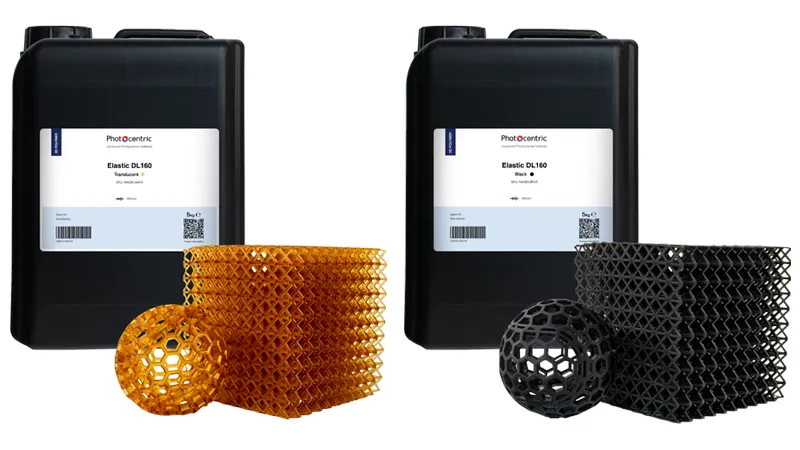
Elastic DL160
The 3D Printing Resin for More Than Just Flexing
DL160 is our elastomeric 3D printing resin, formulated for energy-absorbing applications. We use it to produce breathable, comfortable protective padding for sports, military and consumer goods, as well as components that dampen vibration and shock in demanding assemblies.
We've already produced over 100,000 elastomeric parts with DL160 across multiple customer projects, using our 50-strong LC Magna print farm, part of the UK's largest 3D printing capability. That same infrastructure lets us take a single customer from early R&D samples through to a production orders of 500,000 and beyond, without changing material, process or supplier.
Elastomers span a huge range of properties, and DL160 is built for parts that need to absorb energy, whether that's cushioning an impact or damping a vibration, rather than simply flexing or stretching.
DL160 at a glance
DL160 is formulated to soak up impact energy rather than bounce it back. It has a Shore A hardness of 70, an elongation at break of up to 162% in translucent (149% in black), and a low rebound resilience of just 10%, so energy is absorbed rather than returned to the wearer or structure. A glass transition temperature of -24°C means parts keep performing in cold environments, while low water absorption makes it a suitable candidate for parts that will sit against the skin.
Applications
Ventilated Protective Padding
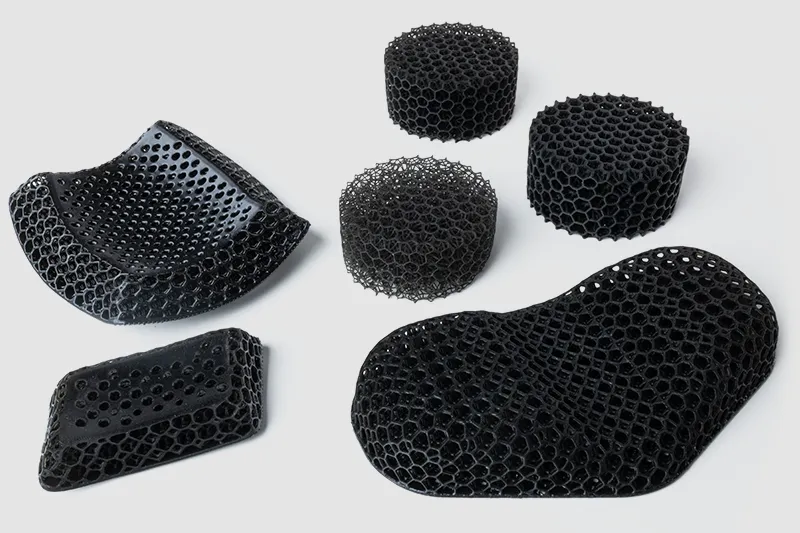
Breathable, comfortable protection pads for sports equipment, military padding, security gear and consumer goods such as lumbar pads and helmet liners. Because parts are 3D printed, padding can be ventilated with fine lattice structures that traditional foam simply can't achieve, keeping the wearer cool without compromising protection.
Vibration Dampening
Components designed to absorb and dissipate vibration, reducing the transfer of shock and movement through a structure. This makes DL160 a strong replacement for foam or rubber isolators in assemblies where consistent, repeatable performance matters.
How does lattice design change what DL160 can do?
The same DL160 material can produce a wide range of finished part properties, and one of the key ways to achieve this is through lattice density. A higher density puts more material in the same volume, producing a harder, stiffer part. Lowering the density leaves more open space, allowing more movement and giving a softer, more compliant result.
This is achieved without any changes to the resin formulation, giving companies the freedom to produce a whole range of parts, with different stiffness, ventilation and cushioning characteristics, from the exact same material. It also means a single design can be tuned and iterated purely through geometry, cutting down on the time and cost normally spent testing different material grades.
We work closely with General Lattice, a partner who takes a CAD model, a section of padding, for example, and turns it into a lattice structure engineered to hit the exact level of dampening and comfort a customer's looking for. It means the tuning we've just described doesn't have to start from a blank file each time.
To show what that looks like in practice, we lowered a 5kg weight onto a set of pucks, each printed in DL160 with a different lattice structure designed by General Lattice. Every puck came off the same LC Magna, printed at the same time from the same resin, so the only variable between them is the lattice itself.
Lattice geometry isn't the only lever, either. Post-processing can also be used to fine-tune rebound properties further, so if your application has specific requirements, that's worth a conversation with our team.

Manufacturing at scale
Our in-house 3D print farm, home to 50 LC Magnas, has produced over 100,000 elastomeric 3D printed parts with DL160.
Innovative companies have been using 3D printing in production for years, and we support our customers at every stage of that journey, from early prototypes through to production volumes in the hundreds of thousands. Because we manufacture both our resins and our printers in-house, we can control every part of the process, giving customers consistent quality, reliable lead times and predictable costs as a project scales.