


From Bond to Batman:
How Bohanna Griffin Associates Brings Blockbuster Props to Life with LC Magna
A conversation with Pierre Bohanna, prop and costume maker and co-founder of Bohanna Griffin Associates
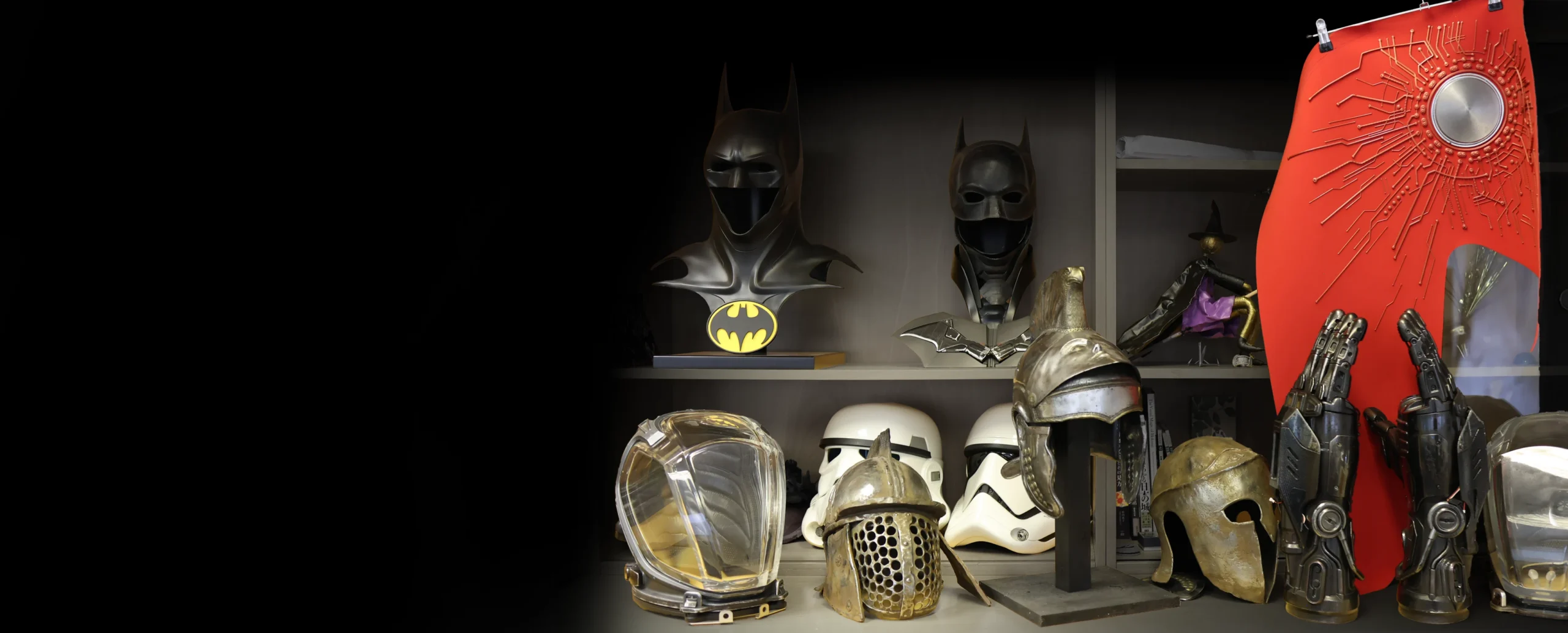
For over three decades, Pierre Bohanna has been one of the film industry's most trusted names in prop and costume making. Through his workshop, Bohanna Griffin Associates, he and his team have built pieces for some of the biggest franchises in cinema history, including the Bond films, all eight Harry Potter films, the recent Star Wars trilogy, Fantastic Beasts, several Batman titles, and more.
We sat down with Pierre to talk about how rapid prototyping, and specifically Photocentric's LC Magna machines, has become a cornerstone of his workshop's process over the last three years, and how it's changed the way his team designs, builds, and delivers props and costumes for the screen.
From Bond to Batman:
How Bohanna Griffin Associates Brings Blockbuster Props to Life with LC Magna
A conversation with Pierre Bohanna, prop and costume maker and co-founder of Bohanna Griffin Associates
For over three decades, Pierre Bohanna has been one of the film industry's most trusted names in prop and costume making. Through his workshop, Bohanna Griffin Associates, he and his team have built pieces for some of the biggest franchises in cinema history, including the Bond films, all eight Harry Potter films, the recent Star Wars trilogy, Fantastic Beasts, several Batman titles, and more.
We sat down with Pierre to talk about how rapid prototyping, and specifically Photocentric's LC Magna machines, has become a cornerstone of his workshop's process over the last three years, and how it's changed the way his team designs, builds, and delivers props and costumes for the screen.
A Career Built on Solving Problems With Creativity
Pierre Bohanna Interview
You've been in prop making since the late 1980s. How has rapid prototyping changed over that time?
Pierre – "One of the interesting things I've had in my career is a fact of seeing rapid prototyping really come in and evolve to where it is now. It's a constant development, and it's really such a powerful process. But like all things, the reality always needs to be considered a lot more than what people hope it will do.
"In the early days, there was a lot of ability to make amazing machines that worked incredibly badly. The capacity of machines was great, but they were highly sensitive and highly unreliable. One of the big joys now is that the capacity for these machines is much more reliable and consistent."
What kind of projects has that capability supported?
Pierre – "We've worked on everything from Bond films to all the Harry Potter series. We've worked on films such as Edge of Tomorrow with Tom Cruise, Gravity, all the recent Star Wars films from Force Awakens right through to Rise of Skywalker, and more recently Fantastic Beasts and several Batman films. A lot of those films have relied more and more on the capacity of producing accurate shapes and patterns based off digital designs, to allow us to adjust and fit and be dynamic with what we're producing."
A Career Built on Solving Problems With Creativity
Pierre Bohanna Interview
You've been in prop making since the late 1980s. How has rapid prototyping changed over that time?
Pierre – "One of the interesting things I've had in my career is a fact of seeing rapid prototyping really come in and evolve to where it is now. It's a constant development, and it's really such a powerful process. But like all things, the reality always needs to be considered a lot more than what people hope it will do.
"In the early days, there was a lot of ability to make amazing machines that worked incredibly badly. The capacity of machines was great, but they were highly sensitive and highly unreliable. One of the big joys now is that the capacity for these machines is much more reliable and consistent."
What kind of projects has that capability supported?
Pierre – "We've worked on everything from Bond films to all the Harry Potter series. We've worked on films such as Edge of Tomorrow with Tom Cruise, Gravity, all the recent Star Wars films from Force Awakens right through to Rise of Skywalker, and more recently Fantastic Beasts and several Batman films. A lot of those films have relied more and more on the capacity of producing accurate shapes and patterns based off digital designs, to allow us to adjust and fit and be dynamic with what we're producing."
Why Bohanna Griffin Associates Chose LC Magna
When it came to choosing which machine to go for, what drew you to the LC Magna?
Pierre – At the time, the LC Magna was a great balance. One of our basic requirements is size. Whenever you buy a machine, the first job you'll get for it, the machine is always too small. Even if it was a three-metre square, you'd always want one that's slightly bigger. In a practical sense, one of the nice things about the LC Magna is its size and its proportion, so you're getting good high quality printing with a good scale.
"The next stage is the fact that Photocentric run so many good resins through it, and we've got an enormous amount of dexterity for that. It's a quality machine.
“We've been burnt a few times with the cheaper end of the market, the Chinese machines and so on, where it works very well on paper, but in reality you're acquiring constant attention, it's shredding its components perpetually, and you're probably losing 30 to 40% of the builds you're going through.
“The LC Magna produces stable, accurate models, which is exactly what you want. Also, it's fairly fast, which is good for an SLA. It can be incredibly quick if you require that."
What about the resins themselves?
Pierre – "One of the big strengths, as well as the quality of the machines, is the range of resins. That's one of the most important aspects of what we need, because the product itself has to be stable, strong, and heat resistant, and different projects require different aspects of those capacities. Photocentric's range of resins has been brilliant for that, and that's a massive plus, and definitely pulled us towards them originally.
"We use the DL110 as probably the cornerstone, because a lot of our work is to produce patterns for moulding. But we've also used the DL110 resin for the Project Hail Mary film, it was a straight-to-camera process, and we were able to do that because the strength of DL110 was incredibly good.

Why Bohanna Griffin Associates Chose LC Magna
When it came to choosing which machine to go for, what drew you to the LC Magna?
Pierre – At the time, the LC Magna was a great balance. One of our basic requirements is size. Whenever you buy a machine, the first job you'll get for it, the machine is always too small. Even if it was a three-metre square, you'd always want one that's slightly bigger. In a practical sense, one of the nice things about the LC Magna is its size and its proportion, so you're getting good high quality printing with a good scale.
"The next stage is the fact that Photocentric run so many good resins through it, and we've got an enormous amount of dexterity for that. It's a quality machine.
“We've been burnt a few times with the cheaper end of the market, the Chinese machines and so on, where it works very well on paper, but in reality you're acquiring constant attention, it's shredding its components perpetually, and you're probably losing 30 to 40% of the builds you're going through.
“The LC Magna produces stable, accurate models, which is exactly what you want. Also, it's fairly fast, which is good for an SLA. It can be incredibly quick if you require that."
What about the resins themselves?
Pierre – "One of the big strengths, as well as the quality of the machines, is the range of resins. That's one of the most important aspects of what we need, because the product itself has to be stable, strong, and heat resistant, and different projects require different aspects of those capacities. Photocentric's range of resins has been brilliant for that, and that's a massive plus, and definitely pulled us towards them originally.
"We use the DL110 as probably the cornerstone, because a lot of our work is to produce patterns for moulding. But we've also used the DL110 resin for the Project Hail Mary film, it was a straight-to-camera process, and we were able to do that because the strength of DL110 was incredibly good.
From Design to Delivery:
The Bohanna Griffin Process
Could you walk us through how a project moves from concept to finished piece?
Pierre – "How work generally comes to us: we'll go and discuss a project, say a helmet or a cowl or a large costume piece. They'll generally have started concept work by then, and often I'll talk to the designer at that stage about the pros and cons of their design, and try to really guide them to make sure they're producing something that's practical. It's strange to say, but often those discussions need to be made.
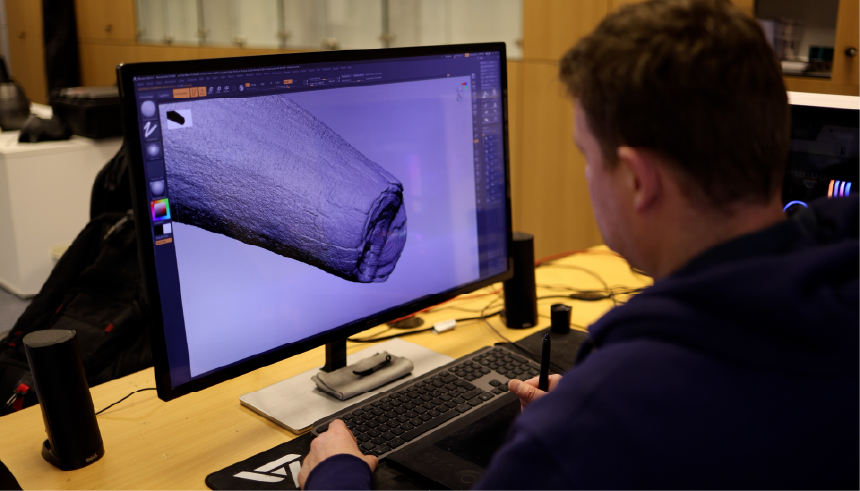
"Once they're happy, and we've had the budget conversation and got an idea of how much work these pieces will have to do, we'll put in a budget, get it signed off, and start the process. Sketches will come in at different standards, and we'll take them into our own CAD systems and CAD designers, and look at them much more in a product sense, thinking about the arrangement of shapes and processes needed to have an effect on those forms, and the specific components required in terms of flexibility, strength, colour and so on.
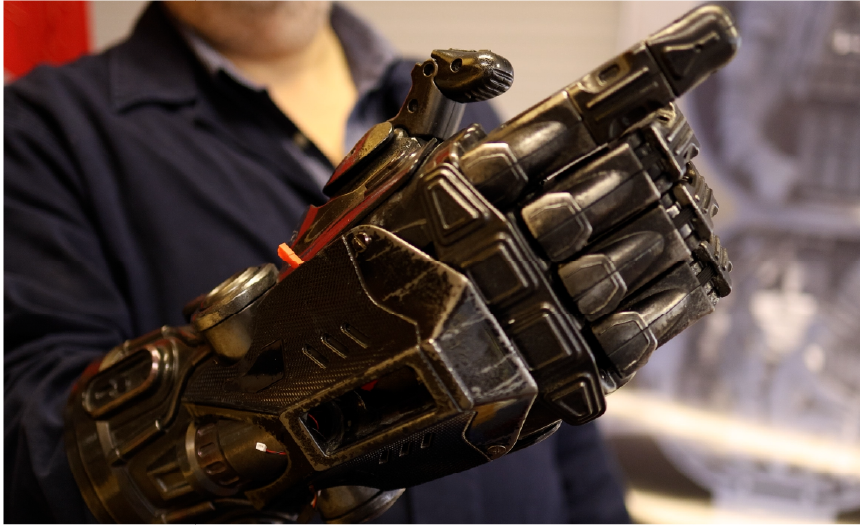
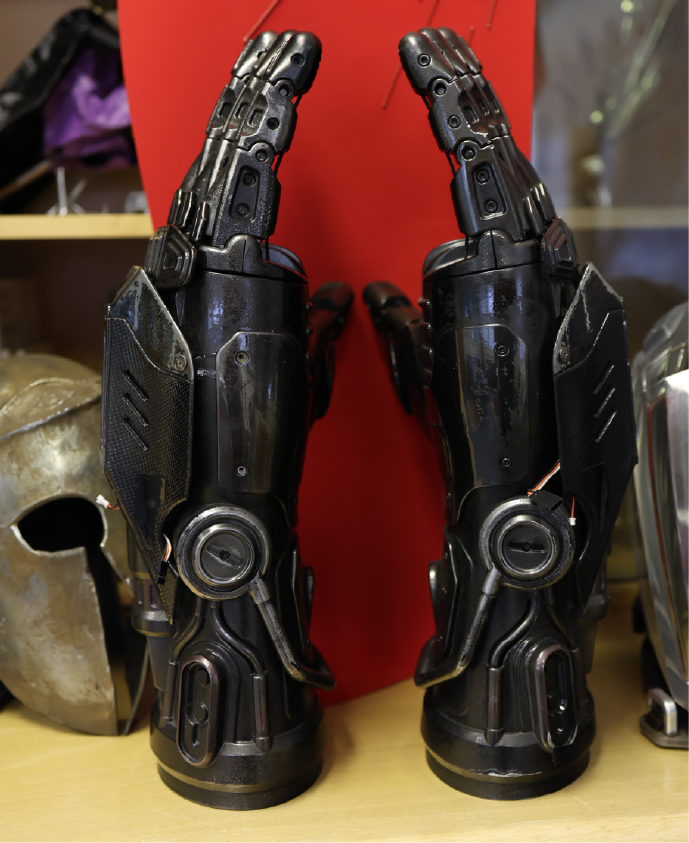
"From there, we generate the shapes and individual components, and they're taken to the Magnas and grown. We'll generally use the durable resins such as DL110, which are good, stable, strong and hold good detail. Once they come off the machines and go through clean-up, the surface may be treated depending on the finish required, and then they go into our moulding processes.
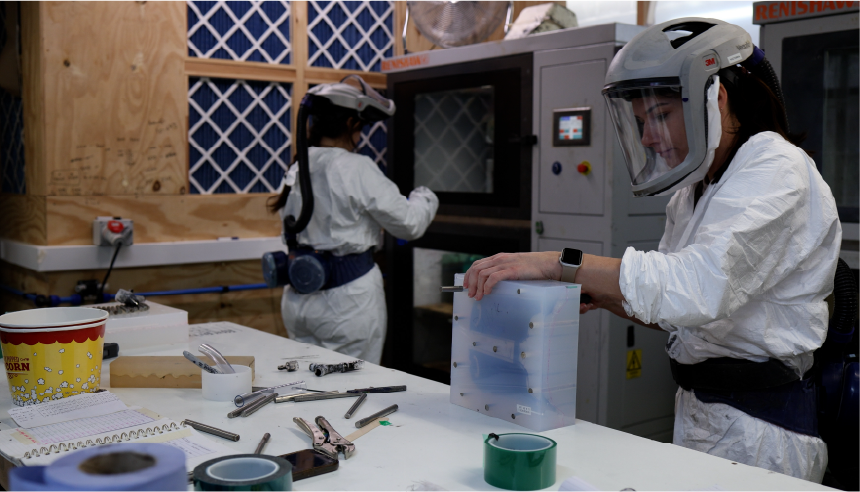
"90% of the time, we'll use a block moulding system: the pattern is suspended in a Perspex box and flood-filled with silicon, and the moulders use a learnt technique of cutting back into the mould with scalpels to produce the components. The mould is prepped, warmed in the oven, and then goes into our vat casting machines to be cast. The vat caster gives us the dexterity to use resins of different strength yields and different colours, from crystal clear through to almost any colour match, and we can control the flexibility from rock hard right down to super soft pieces. Once the castings come out, we clean them up, prep them, and they go into assembly. The costume, made of multiple components, is assembled, art working happens, and then it's into a box, off to the client."
How repeatable does this process need to be?
Pierre – "Our projects, by their nature, are always individual to themselves, so there's always great variety, but you tend to need repeatability, because even though you might see one object on film for only a few minutes, it might go through a lot of stresses and strains if it's used in fights, thrown at someone, or has a specific action it needs to cope with.
“If it's costumes, you need to make stuff that can cope with being very closely looked at, and other times you've got people rolling down a hill and fighting. There's often lots of specific requirements which mean the real piece wouldn't last very long at all, so it does often require a lot of moulding. We tend to fall back onto digital models, digital textures, and then patterns, moulds and casting to allow us to do consistent repeatability.
"But there's also this idea that we can start producing one-off pieces that are good, and it obviously saves a lot of time and money if you can just go straight off the machine. That's now becoming more and more of an option as we move on."
A Cornerstone of Every Project
How central has Magna become to your day-to-day work?
Pierre – "We've owned the Magnas since January 2023, and they've pretty much touched every single project we've been involved in, in one sense or another. If you go on my IMDb, pretty much any film project I've done since then, the LC Magna was involved in. That system of manufacture has been a cornerstone of the process."
Has the LC Magna changed the kind of challenges you can take on?
Pierre – "Everything we receive is a challenge, and that's part of the job. We know we're going to ask to stretch every system, and I like to take on the challenge of doing that. Film prop making is about surprising and entertaining, and doing something novel. Novelty is a strong point, and that requires stretching the parameters of processes and ideas. Magna has been a great asset in feeling confident about doing so."
You mentioned growing confidence in end-use parts straight off the machine. How has that shifted over time?
Pierre – "There's a consideration now that I didn't have before. I now have the confidence to look at the possibility of taking stuff straight off the machine, whereas before working with Photocentric that was never something I had confidence in. Photocentric resins have stability, strength and consistent rigidity to be able to consider that seriously when thinking about how to produce a piece, and specifically which resin to use.
“Photocentric have produced the only resins I've been able to do that with, certainly in SLA, because the strength thresholds and heat resistance are good enough to cope with the reality of the real world.”
Discover Bohanna Art: Pierre Bohanna's Sculpture Studio Powered by LC Magna
Alongside his work in film, Pierre Bohanna also runs Bohanna Art, a sculpture studio where he applies the same craft and precision honed on productions like Harry Potter and Star Wars to bespoke bronze sculptures and gallery pieces. The studio relies on two in-house LC Magna 3D printers to grow digitally sculpted forms before they're hand-finished and cast, including a striking large-scale reproduction of Henri Rousseau's Tiger in a Tropical Storm.
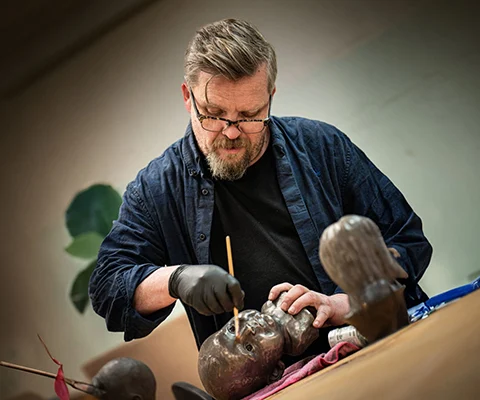
Discover Bohanna Art: Pierre Bohanna's Sculpture Studio Powered by LC Magna
Alongside his work in film, Pierre Bohanna also runs Bohanna Art, a sculpture studio where he applies the same craft and precision honed on productions like Harry Potter and Star Wars to bespoke bronze sculptures and gallery pieces. The studio relies on two in-house LC Magna 3D printers to grow digitally sculpted forms before they're hand-finished and cast, including a striking large-scale reproduction of Henri Rousseau's Tiger in a Tropical Storm.
LC Magna.
Built for Reliability and Consistency.
The LC Magna is a large-format industrial LCD 3D printer designed for both prototyping and production. It combines a high build volume with fine detail, enabling manufacturers to produce large parts or high-volume batches efficiently on a single platform.
Built for reliability and consistency, the LC Magna delivers repeatable results at speed, supported by Photocentric’s ecosystem of materials, software, and post-processing solutions. Its design focuses on reducing production bottlenecks while maintaining industrial-grade accuracy and throughput.
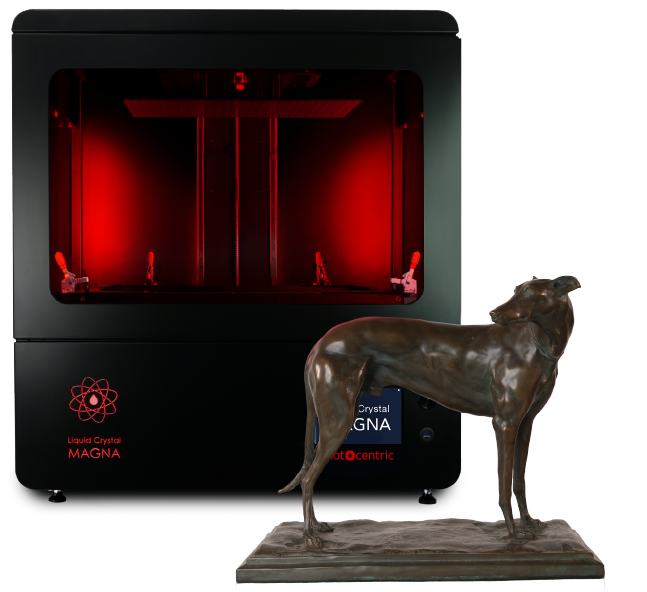
LC Magna.
Built for Reliability and Consistency.
The LC Magna is a large-format industrial LCD 3D printer designed for both prototyping and production. It combines a high build volume with fine detail, enabling manufacturers to produce large parts or high-volume batches efficiently on a single platform.
Built for reliability and consistency, the LC Magna delivers repeatable results at speed, supported by Photocentric’s ecosystem of materials, software, and post-processing solutions. Its design focuses on reducing production bottlenecks while maintaining industrial-grade accuracy and throughput.